Fleetstock Academy
Modern Industrial Technologies Series
Topic No. 0015
Analysis of the Impact of Real-Time Data Collection on Production Costs
Prepared by: Fleetstock Engineers
Publisher: Fleetstock Academy
Version: 1.0
Real-time data collection enables manufacturing enterprises to manage operations with greater transparency, agility, and control. This has a significant impact—both direct and indirect—on production costs.
The Nature of Real-Time Data
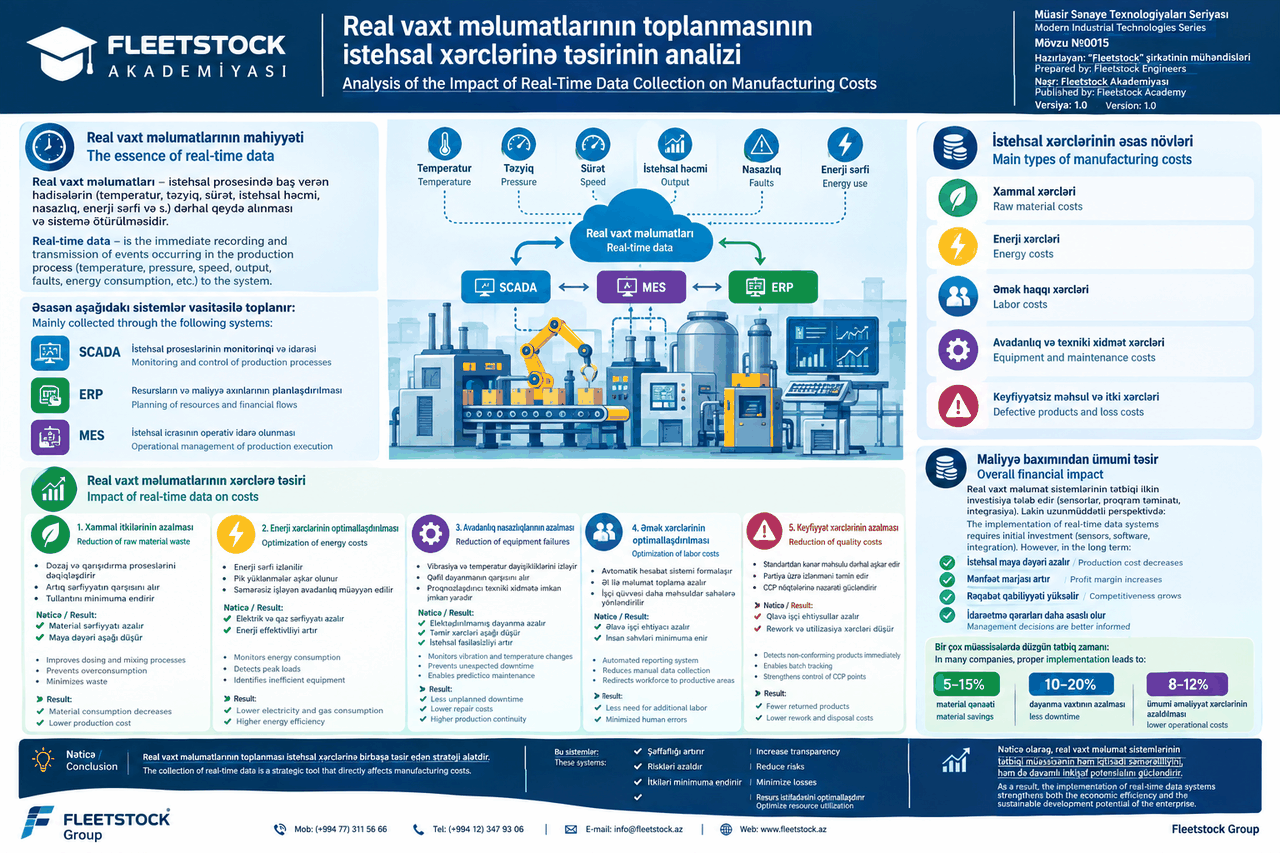
Real-time data refers to the immediate recording and transmission to the system of events occurring during the production process (such as temperature, pressure, speed, production volume, malfunctions, energy consumption, etc.). This data is primarily collected via the following systems:
SCADA – monitoring and control of production processes
ERP – planning of resources and financial flows
MES – operational management of production execution
Main types of production costs
To understand the impact of real-time data, costs can be categorized as follows:
Raw material costs
Energy costs
Labor costs
Equipment and maintenance costs
Costs associated with defective products and waste
3. Impact of real-time data on costs
3.1. Reduction of raw material losses
Real-time monitoring:
Refines dosing and mixing processes
Prevents excessive consumption
Minimizes waste
Result:
✔ Material consumption decreases
✔ Production cost drops
3.2. Optimization of energy costs
Using sensors:
Energy consumption is monitored
Peak loads are detected
Inefficient equipment is identified
Result:
✔ Electricity and gas consumption decreases
✔ Energy efficiency increases
3.3. Reduction in equipment failures
Real-time data:
Monitors vibration and temperature changes
Prevents sudden shutdowns
Enables predictive maintenance
Result:
✔ Reduced unplanned downtime
✔ Lower repair costs
✔ Increased production continuity
3.4. Optimization of labor costs
Automated reporting system established
Reduced manual data collection
Workforce redirected to more productive areas
Result:
✔ Reduced need for additional staff
✔ Minimized human error
3.5. Reduction in quality-related costs
Real-time quality control:
Immediately detects non-standard products
Ensures batch traceability
Strengthens monitoring of Critical Control Points (CCPs)
Result:
✔ Fewer product returns
✔ Lower costs for rework and disposal
Overall financial impact
Implementing real-time data systems requires an initial investment (sensors, software, integration). However, in the long term:
Production costs decrease
Profit margins increase
Competitiveness improves
Management decisions become more well-founded
When properly implemented in many enterprises, the following are observed:
5–15% savings on materials
10–20% reduction in downtime
8–12% reduction in overall operating costs
5. Conclusion
Real-time data collection is a strategic tool that directly impacts production costs.
These systems:
Increase transparency
Reduce risks
Minimize waste
Optimize resource utilization
Ultimately, the implementation of real-time data systems strengthens both the enterprise's economic efficiency and its potential for sustainable growth.
Contact us
Mobile: (+994 77) 311 56 66
Tel: (+994 12) 347 93 06
E-mail: info@fleetstock.az
Web: www.fleetstock.az
Fleetstock Group