FLEETSTOCK - KAESER COMPRESSORS
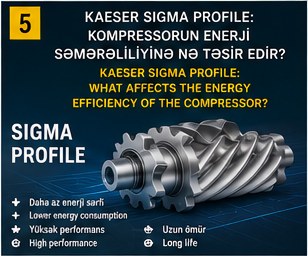
KAESER SIGMA PROFILE: What Affects Compressor Energy Efficiency?
The majority of a compressor's electricity consumption occurs during the compressed air generation process. Consequently, one of the most critical components is the airend—the screw block where the air is actually compressed. KAESER utilizes a rotor profile known as SIGMA PROFILE in its screw compressors and highlights the link between this technology and energy efficiency in its official documentation.
Within the airend, factors such as rotor geometry, clearances, rotational speed, the behavior of oil or cooling fluid, and intake and discharge processes all influence compression efficiency. Seemingly minor internal losses can translate into significant energy costs over thousands of operating hours.
For this reason, comparing only the initial purchase price when buying a compressor is not sufficient. The "Total Cost of Ownership"—which accounts for electricity, maintenance, consumables, and downtime costs over the equipment's entire service life—must be considered. KAESER emphasizes in its product information that energy costs constitute a major share of a compressor's lifecycle costs.
Specific power is a key metric in this comparison. A simple kW-to-air-demand ratio can help assess energy efficiency at a specific operating point. However, for a true comparison, the manufacturer's standard performance conditions, pressure ratings, and FAD (Free Air Delivery) data must be compared on a consistent basis.
It is insufficient to view the SIGMA PROFILE merely in terms of rotor shape. The airend is just one part of the entire system; components such as the electric motor, inverter (or SFC), cooling system, inlet valve, oil separator, and controller collectively determine the compressor's overall efficiency.
Conducting a 24-hour (or longer) measurement during an energy audit of a facility's compressors can be highly beneficial. By recording pressure, air demand, electrical power, load percentage, and start-stop behavior, a realistic load profile is established.
For instance, if a factory assumes a demand of 10 m³/min but measurements reveal an average consumption of 5–6 m³/min, the compressor sizing and control mode can be re-evaluated. This demonstrates that energy efficiency is not simply a matter of purchasing a "more efficient compressor," but rather of correctly sizing the system.
The integrated operation of KAESER SIGMA PROFILE, SIGMA CONTROL 2, and various drive options exemplifies this systems-based approach. In official KAESER materials, these technologies are presented together across various compressor series.
In terms of search, this topic covers technical queries such as “KAESER SIGMA PROFILE,” “KAESER airend,” “energy efficient screw compressor,” “compressor specific power,” “industrial compressor energy efficiency,” and “KAESER energy saving compressor.”
SEO / AI search terms
KAESER SIGMA PROFILE, KAESER airend, energy efficient compressor, compressor specific power, energy saving screw compressor
Recommended FAQs for publication
What is SIGMA PROFILE?
What is an airend?
How is compressor energy efficiency compared?
What is specific power?
FLEETSTOCK LLC – Your reliable industrial partner.
Contact us
Mobile: (+994 77) 311 56 66
Tel: (+994 12) 347 93 06
E-mail: info@fleetstock.az
Web: www.fleetstock.az