FLEETSTOCK ACADEMY
MODERN INDUSTRIAL TECHNOLOGIES SERIES
Topic No. 0013
DIGITAL TRANSFORMATION IN MANUFACTURING ENTERPRISES AND OPTIMIZATION OF QUALITY MANAGEMENT SYSTEMS
Prepared by: Fleetstock Engineers
Publication: Fleetstock Academy
Version: 1.0
⸻
INTRODUCTION
In the modern industrial environment, the competitiveness of manufacturing enterprises is determined not only by production volume, but also by product quality, process efficiency, effective resource utilization, operational safety, and the ability to adapt to changing market requirements.
One of the major challenges faced by modern manufacturing enterprises is the collection, processing, and integration of large volumes of production data from different sources into effective decision-making processes. In traditional management systems, storing information in paper-based documents or separate systems can result in information loss, delayed decisions, and errors caused by human factors.
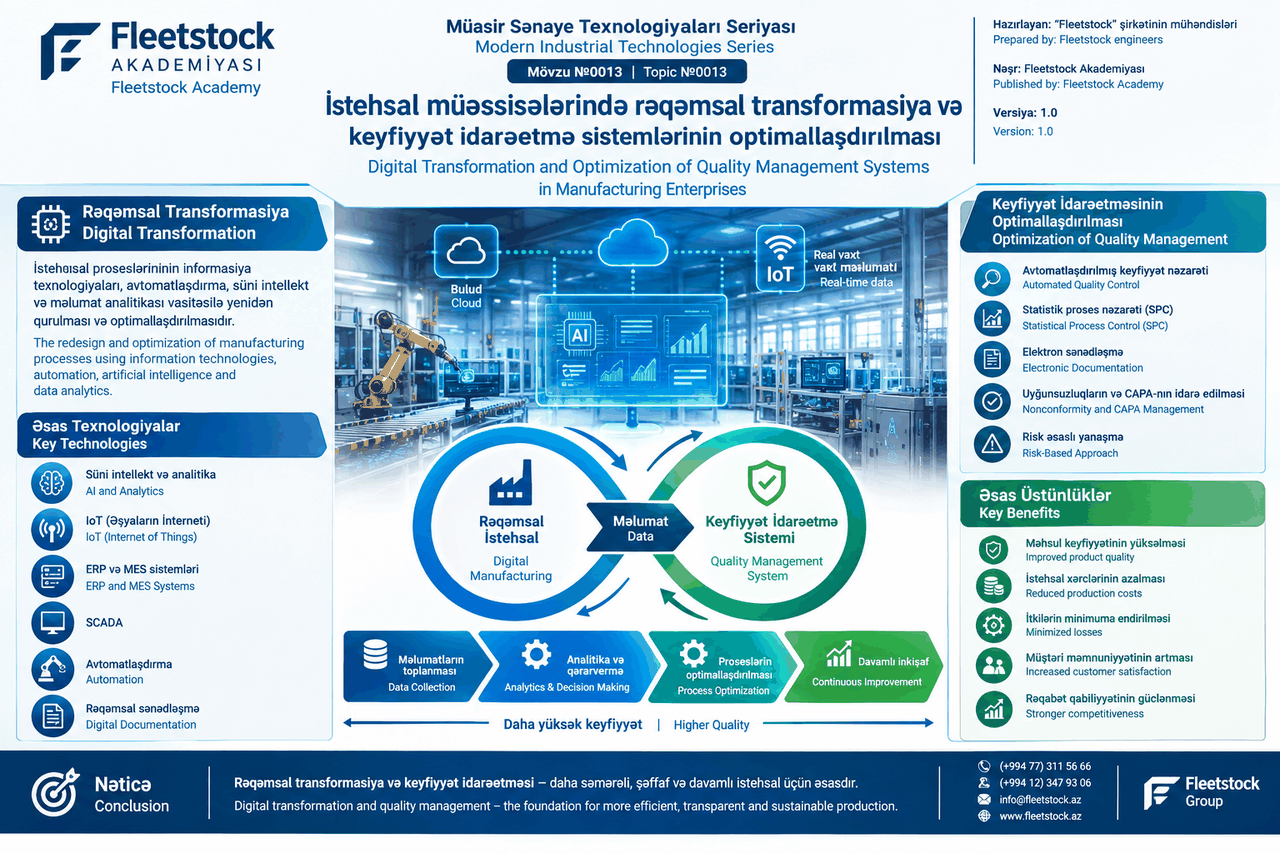
Digital transformation is the process of restructuring and optimizing an enterprise’s technological, informational, and management processes through digital technologies.
This process may include industrial automation, Industrial Internet of Things (IIoT), artificial intelligence, data analytics, ERP, MES, SCADA, digital documentation, and other technological solutions.
The primary objective of digital transformation is not simply to collect data, but to transform data into measurable, traceable, and decision-supporting information.
⸻
1. THE ESSENCE AND IMPORTANCE OF DIGITAL TRANSFORMATION
Digital transformation does not simply mean computerizing an enterprise. It involves integrating processes ranging from production planning and manufacturing to quality control and technical maintenance within a unified digital management environment.
The main areas include:
* Transition from paper-based documentation to electronic documentation;
* Real-time collection of production data;
* Implementation of sensors and measurement systems;
* Automation of equipment and production processes;
* Integration of ERP and MES systems;
* Application of artificial intelligence and data analytics;
* Implementation of electronic Quality Management Systems;
* Digital monitoring of equipment condition;
* Data-driven risk management.
A properly designed digital system can provide the following benefits:
* Greater transparency of production processes;
* Improved accessibility of information;
* Reduction of certain errors caused by human factors;
* Improved process traceability;
* Faster monitoring of production indicators;
* Easier identification of resource and time losses;
* Stronger control over quality indicators.
⸻
2. APPLICATION OF DIGITAL TECHNOLOGIES IN MANUFACTURING
2.1. Artificial Intelligence and Data Analytics
Artificial intelligence and machine learning enable manufacturing enterprises to analyze large volumes of data and develop predictive capabilities for specific processes.
Artificial intelligence can be applied in the following areas:
* Predictive Maintenance;
* Early detection of equipment failures;
* Automatic identification of product defects;
* Optimization of production parameters;
* Energy consumption analysis;
* Optimization of production planning;
* Demand and consumption forecasting;
* Detection of process anomalies.
For example, if a compressor’s temperature, vibration, pressure, and energy consumption are continuously recorded, analytical algorithms can identify deviations from normal operating conditions.
This approach creates an opportunity to move from maintenance performed only after a failure occurs toward a more systematic predictive maintenance model.
⸻
2.2. Industrial IoT – IIoT
Industrial Internet of Things (IIoT) is a set of technologies that enables industrial equipment to exchange information through sensors and communication systems.
IIoT can be used to monitor the following parameters in real time:
* Temperature;
* Pressure;
* Flow rate;
* Vibration;
* Humidity;
* Electric current;
* Voltage;
* Motor speed;
* Energy consumption;
* Equipment operating hours.
At critical stages of production, this information can be automatically transmitted to a central information system.
As a result, an operator can not only view a current parameter, but also monitor its historical data, trend, and proximity to predefined limits.
⸻
2.3. ERP, MES and SCADA Systems
The integration of different information systems is an important component of a digital manufacturing environment.
ERP (Enterprise Resource Planning) systems are used to manage business processes such as finance, procurement, warehousing, sales, human resources, and other organizational functions.
MES (Manufacturing Execution System) systems manage production execution and provide operational control of manufacturing data.
SCADA (Supervisory Control and Data Acquisition) systems are used for monitoring and supervisory control of industrial equipment and processes.
Proper integration of these systems can establish an information flow such as:
ERP → Production Plan → MES → Manufacturing Process → SCADA/PLC → Sensors
This enables the enterprise to reduce information fragmentation between departments and establish a unified information environment.
⸻
3. DIGITALIZATION OF QUALITY MANAGEMENT SYSTEMS
In modern manufacturing enterprises, a Quality Management System should not be limited to inspection of the finished product.
The primary objective should be to manage quality throughout all stages of the production process.
Digital technologies can support the development of Quality Management Systems in the following areas.
3.1. Automated Quality Control
Digital measurement systems can be used to automatically or semi-automatically monitor:
* Product dimensions;
* Temperature;
* Pressure;
* Flow rate;
* Concentration;
* Weight;
* Visual defects;
* Other technical parameters.
Machine vision and computer vision technologies can also be applied to detect visual defects in suitable products.
⸻
3.2. Statistical Process Control – SPC
Statistical Process Control (SPC) enables manufacturing processes to be monitored using statistical indicators.
SPC can be used to analyze:
* Process variation;
* Mean values;
* Standard deviation;
* Control limits;
* Trends and anomalies.
One of the main objectives of this approach is to identify a problem within the process itself rather than only during final product inspection.
⸻
4. ELECTRONIC DOCUMENTATION AND INFORMATION MANAGEMENT
Electronic document management is one of the key elements of a digital Quality Management System.
The system can provide:
* Electronic storage of procedures;
* Management of work instructions;
* Document version control;
* Electronic approval workflows;
* Digital archiving of audit documents;
* Electronic signatures and approval mechanisms;
* Access-right management.
This can reduce the risk of employees using outdated versions of procedures or work instructions.
⸻
5. NONCONFORMITY AND CORRECTIVE ACTION MANAGEMENT
In quality management, simply recording a nonconformity is not sufficient. Its cause, impact, and measures to prevent recurrence should also be investigated.
A digital system can manage the following processes on a unified platform:
Nonconformity Detection → Registration → Root Cause Analysis → Risk Assessment → Action Definition → Implementation → Effectiveness Verification → Closure
This approach facilitates the management and monitoring of CAPA – Corrective and Preventive Actions.
As the database grows, the enterprise can identify recurring problems and investigate their systemic causes.
⸻
6. RISK-BASED DIGITAL QUALITY MANAGEMENT
Digital transformation enables quality management to be integrated with a risk-based approach.
Risk assessment may consider:
* Process complexity;
* Potential failure;
* Consequences of failure;
* Probability of occurrence;
* Detectability;
* Critical control points.
Storing risk indicators in a digital system makes it possible to monitor how risks change over time.
⸻
7. STAGES OF DIGITAL TRANSFORMATION IMPLEMENTATION
Digital transformation is not a one-time project. It is a phased and continuous development process.
Stage I – Assessment of the Current State
The following areas are analyzed:
* Technological infrastructure;
* Information systems;
* Production processes;
* Quality management system;
* Information flows;
* Human resources.
Stage II – Identification of Problems and Risks
Major losses, information gaps, recurring errors, and weak points in processes are identified.
Stage III – Selection of Technological Solutions
ERP, MES, SCADA, IIoT, analytics, automation, and other technologies are selected according to the enterprise’s requirements.
Stage IV – Pilot Project
Instead of attempting to digitalize the entire enterprise simultaneously, a pilot project can be implemented in a critical and measurable process.
Stage V – Workforce Training
The success of a digital system depends not only on technology but also on the competence and preparedness of the personnel using it.
Stage VI – Integration
After evaluating the pilot project’s results, the system can be integrated into other production areas.
Stage VII – Continuous Monitoring and Improvement
KPIs are established and results are regularly monitored and analyzed.
⸻
8. KEY PERFORMANCE INDICATORS – KPIs
Measurable indicators should be used to evaluate the results of digital transformation.
Examples include:
* OEE – Overall Equipment Effectiveness;
* Equipment downtime;
* Product defect rate;
* First Pass Yield (FPY);
* Production cycle time;
* Energy consumption;
* Maintenance costs;
* Unplanned downtime;
* CAPA closure time;
* Frequency of recurring nonconformities;
* Number of customer complaints.
Regular or real-time monitoring of KPIs through digital dashboards can provide management and engineering personnel with more timely information.
⸻
9. BENEFITS OF DIGITAL TRANSFORMATION
A properly planned digital transformation can provide an enterprise with the following capabilities:
* More systematic management of product quality;
* Reduction of process variation;
* Identification of production losses;
* Improved monitoring of equipment operating conditions;
* Improved planning of maintenance activities;
* Faster access to information;
* Data-driven decision-making;
* Faster documentation processes;
* Easier preparation for audits;
* Improved production process traceability.
However, digitalization itself does not automatically solve all operational problems. Successful implementation requires proper process definition, data quality, cybersecurity, personnel training, and correct integration of systems.
⸻
10. DIGITAL TRANSFORMATION AND CONTINUOUS DEVELOPMENT
Digital transformation is not simply the electronic conversion of existing processes. It is also the development of a future-oriented operational model for the enterprise.
Data Collection → Data Processing → Analytics → Decision-Making → Process Optimization → Performance Measurement
This cycle creates a digital foundation for continuous improvement.
When integrated with a Quality Management System, this approach can establish a data-driven culture of continuous improvement within the enterprise.
⸻
CONCLUSION
Digital transformation and the optimization of Quality Management Systems in manufacturing enterprises represent important development directions for modern industry.
The proper implementation of IIoT, artificial intelligence, data analytics, ERP, MES, SCADA, and automation technologies can make manufacturing processes more transparent, measurable, and manageable.
A Digital Quality Management System can integrate data collection, quality monitoring, nonconformity management, risk assessment, and corrective action tracking within a unified environment.
The objective is not simply to acquire new technologies. The fundamental objective is to integrate data, technology, people, and management processes into one efficient and coherent system.
Such an approach can create a strong digital foundation for continuous process improvement, consistent quality, and more efficient utilization of resources.
⸻
FLEETSTOCK ACADEMY
Modern Industrial Technologies Series
Topic No. 0013
Digital Transformation | Rəqəmsal Transformasiya
Quality Management System | Keyfiyyət İdarəetmə Sistemi
Industrial IoT | AI | ERP | MES | SCADA | SPC | CAPA | KPI
Prepared by: Fleetstock Engineers
Publication: Fleetstock Academy
Version: 1.0
Contact Us
Mobile: (+994 77) 311 56 66
Tel: (+994 12) 347 93 06
E-mail: info@fleetstock.az
Web: www.fleetstock.az
Fleetstock Group